Fake Driver Object
A manually mapped driver without a DRIVER_OBJECT is deaf and mute. It can run internal threads and manipulate memory, but it cannot safely interact with standard Windows I/O subsystems. Crafting a structurally perfect fake driver object is the bridge that allows a ghost module to use standard, powerful Windows APIs without crashing the system or triggering immediate detection. This technique is used in my project YetAnotherReflectiveLoader, I have intentionally not uploaded this specific code for security reasons, but we will talk about the logic here in this blog.
Setup
Everything which we are going to talk about is done on latest Windows and defender versions, which at the time of writing this blog are -
Windows OS
- Edition: Windows 11 Pro
- Version:
25H2 - OS Build:
26200.7840
Defender Engine
- Client:
4.18.26010.5 - Engine:
1.1.26010.1 - AV / AS:
1.445.222.0
Environment
Everything is created and built to test modern security with security features:
✓ Real-time protection
✓ Tamper Protection
✓ Memory integrity
✓ Memory access protection
✗ Microsoft Vulnerable Driver Blocklist
This is some serious work, hence should be used with care and made just for education and research purposes.
What is a Driver Object
A DRIVER_OBJECT is the Windows kernel’s official representation of a loaded driver. Whenever the OS loads a legitimate .sys file into memory, the I/O Manager allocates and initializes this structure to act as the brain for that driver. The DRIVER_OBJECT strucutre looks like:
//0x150 bytes (sizeof)
struct _DRIVER_OBJECT
{
    SHORT Type;                                                             //0x0
    SHORT Size;                                                             //0x2
    struct _DEVICE_OBJECT* DeviceObject;                                    //0x8
    ULONG Flags;                                                            //0x10
    VOID* DriverStart;                                                      //0x18
    ULONG DriverSize;                                                       //0x20
    VOID* DriverSection;                                                    //0x28
    struct _DRIVER_EXTENSION* DriverExtension;                              //0x30
    struct _UNICODE_STRING DriverName;                                      //0x38
    struct _UNICODE_STRING* HardwareDatabase;                               //0x48
    struct _FAST_IO_DISPATCH* FastIoDispatch;                               //0x50
    LONG (*DriverInit)(struct _DRIVER_OBJECT* arg1, struct _UNICODE_STRING* arg2); //0x58
    VOID (*DriverStartIo)(struct _DEVICE_OBJECT* arg1, struct _IRP* arg2);  //0x60
    VOID (*DriverUnload)(struct _DRIVER_OBJECT* arg1);                      //0x68
    LONG (*MajorFunction[28])(struct _DEVICE_OBJECT* arg1, struct _IRP* arg2); //0x70
};
Microsoft learn also provides a very nice documentationEXTERNAL LINK TOhttps://learn.microsoft.com/en-us/windows-hardware/drivers/ddi/wdm/ns-wdm-_driver_object, which you can have a look at.
The
DRIVER_OBJECT structure contains dozens of fields, but four primary components dictate how a driver actually interacts with the Windows Operating System:
This is the most important part of the structure. It is an array of up to 28 function pointers (IRP_MJ_CREATE, IRP_MJ_READ, IRP_MJ_DEVICE_CONTROL).
When a user-mode application calls DeviceIoControl or ReadFile, the Windows I/O Manager packages that request into an IRP, looks up this array in the target's DRIVER_OBJECT, and jumps to the function pointer registered there.
A single driver can manage multiple devices (for example, a single disk driver managing three different hard drives).
The DRIVER_OBJECT contains a pointer to the very first DEVICE_OBJECT it created. Each device then points to the next one, creating a linked list. When the driver is unloaded, the OS uses this list to ensure all child devices are cleanly destroyed.
The structure holds pointers to functions that dictate the driver's lifecycle:
• DriverUnload: The function the OS calls when it's time to safely remove the driver from memory.
• DriverStartIo: Used for serializing hardware I/O requests.
• AddDevice: Used heavily by Plug-and-Play (PnP) drivers when new hardware is plugged in.
The structure holds a UNICODE_STRING pointing to the driver's location in the Windows Object Manager namespace.
(e.g., \Driver\kbdclass or \Driver\Tcp).
This is how the OS and other drivers locate it by name.
Reversing IoCreateDriver
Before making a fake Driver_Object we must see how the OS does it. For this we can look at IoCreateDriver inside IDA
If you want to review the complete, unedited logic of IoCreateDriver, you can expand the block below to switch between the raw IDA disassembly and the generated HexRays pseudocode.
Expand to view the complete MiLockVadTree function
MiLockVadTree function- IDA Pro Assembly
- HexRays Pseudocode
PAGE:0000000140AACA20 ; Exported entry 876. IoCreateDriver
PAGE:0000000140AACA20
PAGE:0000000140AACA20 ; =============== S U B R O U T I N E =======================================
PAGE:0000000140AACA20
PAGE:0000000140AACA20 ; Attributes: bp-based frame fpd=70h
PAGE:0000000140AACA20
PAGE:0000000140AACA20 ; __int64 __fastcall IoCreateDriver(_OWORD *, __int64)
PAGE:0000000140AACA20                 public IoCreateDriver
PAGE:0000000140AACA20 IoCreateDriver  proc near               ; CODE XREF: HaliInitPnpDriver+25↑p
PAGE:0000000140AACA20                                         ; CmpBuildMachineHiveCache+27↑p ...
PAGE:0000000140AACA20
PAGE:0000000140AACA20 Object          = qword ptr -150h
PAGE:0000000140AACA20 HandleInformation= qword ptr -148h
PAGE:0000000140AACA20 var_140         = qword ptr -140h
PAGE:0000000140AACA20 var_138         = dword ptr -138h
PAGE:0000000140AACA20 var_130         = qword ptr -130h
PAGE:0000000140AACA20 var_128         = qword ptr -128h
PAGE:0000000140AACA20 Src             = qword ptr -120h
PAGE:0000000140AACA20 Handle          = qword ptr -110h
PAGE:0000000140AACA20 var_108         = qword ptr -108h
PAGE:0000000140AACA20 var_100         = qword ptr -100h
PAGE:0000000140AACA20 var_F8          = xmmword ptr -0F8h
PAGE:0000000140AACA20 var_E8          = dword ptr -0E8h
PAGE:0000000140AACA20 var_E4          = dword ptr -0E4h
PAGE:0000000140AACA20 var_E0          = qword ptr -0E0h
PAGE:0000000140AACA20 var_D8          = qword ptr -0D8h
PAGE:0000000140AACA20 var_D0          = dword ptr -0D0h
PAGE:0000000140AACA20 var_CC          = dword ptr -0CCh
PAGE:0000000140AACA20 var_C8          = xmmword ptr -0C8h
PAGE:0000000140AACA20 pszDest         = word ptr -0B0h
PAGE:0000000140AACA20 var_30          = qword ptr -30h
PAGE:0000000140AACA20 var_20          = byte ptr -20h
PAGE:0000000140AACA20 arg_10          = qword ptr  20h
PAGE:0000000140AACA20 arg_18          = qword ptr  28h
PAGE:0000000140AACA20
PAGE:0000000140AACA20 ; __unwind { // __GSHandlerCheck
PAGE:0000000140AACA20                 mov     [rsp-8+arg_10], rbx
PAGE:0000000140AACA25                 mov     [rsp-8+arg_18], rsi
PAGE:0000000140AACA2A                 push    rbp
PAGE:0000000140AACA2B                 push    rdi
PAGE:0000000140AACA2C                 push    r12
PAGE:0000000140AACA2E                 push    r14
PAGE:0000000140AACA30                 push    r15
PAGE:0000000140AACA32                 lea     rbp, [rsp-50h]
PAGE:0000000140AACA37                 sub     rsp, 150h
PAGE:0000000140AACA3E                 mov     rax, cs:RtlCopyFromUser_$fo$
PAGE:0000000140AACA45                 xor     rax, rsp
PAGE:0000000140AACA48                 mov     [rbp+70h+var_30], rax
PAGE:0000000140AACA4C                 xor     r15d, r15d
PAGE:0000000140AACA4F                 xorps   xmm0, xmm0
PAGE:0000000140AACA52                 mov     [rbp+70h+var_E4], r15d
PAGE:0000000140AACA56                 xorps   xmm1, xmm1
PAGE:0000000140AACA59                 mov     [rbp+70h+var_CC], r15d
PAGE:0000000140AACA5D                 mov     rsi, rdx
PAGE:0000000140AACA60                 mov     [rsp+170h+var_100], r15
PAGE:0000000140AACA65                 mov     [rsp+170h+Handle], r15
PAGE:0000000140AACA6A                 lea     r12d, [r15+2]
PAGE:0000000140AACA6E                 mov     [rsp+170h+var_108], r15
PAGE:0000000140AACA73                 movups  xmmword ptr [rsp+170h+Src], xmm0
PAGE:0000000140AACA78                 movups  [rsp+170h+var_F8], xmm1
PAGE:0000000140AACA7D                 test    rcx, rcx
PAGE:0000000140AACA80                 jnz     loc_140AACB16
PAGE:0000000140AACA86                 lea     r9d, [r15+1]
PAGE:0000000140AACA8A                 lock xadd cs:IopUniqueDriverObjectNumber, r9d
PAGE:0000000140AACA93                 lea     ebx, [rcx+3Ch]
PAGE:0000000140AACA96                 inc     r9d
PAGE:0000000140AACA99                 mov     edx, ebx        ; cchDest
PAGE:0000000140AACA9B                 lea     r8, aDriver08u  ; "\\Driver\\%08u"
PAGE:0000000140AACAA2                 lea     rcx, [rbp+70h+pszDest] ; pszDest
PAGE:0000000140AACAA6                 call    RtlStringCchPrintfW
PAGE:0000000140AACAAB                 lea     rax, [rbp+70h+pszDest]
PAGE:0000000140AACAAF                 mov     edi, ebx
PAGE:0000000140AACAB1
PAGE:0000000140AACAB1 loc_140AACAB1:                          ; CODE XREF: IoCreateDriver+9E↓j
PAGE:0000000140AACAB1                 cmp     [rax], r15w
PAGE:0000000140AACAB5                 jz      short loc_140AACAC0
PAGE:0000000140AACAB7                 add     rax, r12
PAGE:0000000140AACABA                 sub     rdi, 1
PAGE:0000000140AACABE                 jnz     short loc_140AACAB1
PAGE:0000000140AACAC0
PAGE:0000000140AACAC0 loc_140AACAC0:                          ; CODE XREF: IoCreateDriver+95↑j
PAGE:0000000140AACAC0                 mov     rax, rdi
PAGE:0000000140AACAC3                 mov     rcx, rdi
PAGE:0000000140AACAC6                 neg     rax
PAGE:0000000140AACAC9                 sbb     eax, eax
PAGE:0000000140AACACB                 sub     rbx, rdi
PAGE:0000000140AACACE                 not     eax
PAGE:0000000140AACAD0                 and     eax, 0C000000Dh
PAGE:0000000140AACAD5                 neg     rcx
PAGE:0000000140AACAD8                 sbb     rdx, rdx
PAGE:0000000140AACADB                 and     rdx, rbx
PAGE:0000000140AACADE                 test    rdi, rdi
PAGE:0000000140AACAE1                 jz      loc_140AACD38
PAGE:0000000140AACAE7                 cmp     rdx, 0FFFFh
PAGE:0000000140AACAEE                 jbe     short loc_140AACAFA
PAGE:0000000140AACAF0                 mov     eax, 80000005h
PAGE:0000000140AACAF5                 jmp     loc_140AACD38
PAGE:0000000140AACAFA ; ---------------------------------------------------------------------------
PAGE:0000000140AACAFA
PAGE:0000000140AACAFA loc_140AACAFA:                          ; CODE XREF: IoCreateDriver+CE↑j
PAGE:0000000140AACAFA                 add     dx, dx
PAGE:0000000140AACAFD                 lea     rax, [rbp+70h+pszDest]
PAGE:0000000140AACB01                 mov     word ptr [rsp+170h+Src], dx
PAGE:0000000140AACB06                 add     dx, r12w
PAGE:0000000140AACB0A                 mov     word ptr [rsp+170h+Src+2], dx
PAGE:0000000140AACB0F                 mov     [rsp+170h+Src+8], rax
PAGE:0000000140AACB14                 jmp     short loc_140AACB1F
PAGE:0000000140AACB16 ; ---------------------------------------------------------------------------
PAGE:0000000140AACB16
PAGE:0000000140AACB16 loc_140AACB16:                          ; CODE XREF: IoCreateDriver+60↑j
PAGE:0000000140AACB16                 movups  xmm0, xmmword ptr [rcx]
PAGE:0000000140AACB19                 movdqu  xmmword ptr [rsp+170h+Src], xmm0
PAGE:0000000140AACB1F
PAGE:0000000140AACB1F loc_140AACB1F:                          ; CODE XREF: IoCreateDriver+F4↑j
PAGE:0000000140AACB1F                 mov     rdx, cs:IoDriverObjectType
PAGE:0000000140AACB26                 lea     rax, [rsp+170h+Src]
PAGE:0000000140AACB2B                 mov     [rsp+170h+var_128], r15
PAGE:0000000140AACB30                 lea     r8, [rbp+70h+var_E8]
PAGE:0000000140AACB34                 mov     [rbp+70h+var_D8], rax
PAGE:0000000140AACB38                 xorps   xmm0, xmm0
PAGE:0000000140AACB3B                 lea     rax, [rsp+170h+var_100]
PAGE:0000000140AACB40                 mov     [rbp+70h+var_E8], 30h ; '0'
PAGE:0000000140AACB47                 mov     [rsp+170h+var_130], rax
PAGE:0000000140AACB4C                 mov     edi, 1A8h
PAGE:0000000140AACB51                 mov     [rsp+170h+var_138], r15d
PAGE:0000000140AACB56                 xor     r9d, r9d
PAGE:0000000140AACB59                 mov     dword ptr [rsp+170h+var_140], r15d
PAGE:0000000140AACB5E                 xor     ecx, ecx
PAGE:0000000140AACB60                 mov     dword ptr [rsp+170h+HandleInformation], edi
PAGE:0000000140AACB64                 mov     [rbp+70h+var_E0], r15
PAGE:0000000140AACB68                 mov     [rbp+70h+var_D0], 250h
PAGE:0000000140AACB6F                 movdqu  [rbp+70h+var_C8], xmm0
PAGE:0000000140AACB74                 call    ObCreateObjectEx
PAGE:0000000140AACB79                 test    eax, eax
PAGE:0000000140AACB7B                 js      loc_140AACD38
PAGE:0000000140AACB81                 mov     rbx, [rsp+170h+var_100]
PAGE:0000000140AACB86                 mov     r8d, edi        ; Size
PAGE:0000000140AACB89                 mov     rcx, rbx        ; void *
PAGE:0000000140AACB8C                 xor     edx, edx        ; Val
PAGE:0000000140AACB8E                 call    memset_0
PAGE:0000000140AACB93                 lea     rax, [rbx+150h]
PAGE:0000000140AACB9A                 mov     ecx, 4
PAGE:0000000140AACB9F                 mov     [rbx+30h], rax
PAGE:0000000140AACBA3                 lea     rdi, [rbx+70h]
PAGE:0000000140AACBA7                 mov     [rax], rbx
PAGE:0000000140AACBAA                 lea     rdx, [rsp+170h+var_108]
PAGE:0000000140AACBAF                 mov     dword ptr [rbx], 1500004h
PAGE:0000000140AACBB5                 lea     rax, IopInvalidDeviceRequest
PAGE:0000000140AACBBC                 mov     [rbx+10h], ecx
PAGE:0000000140AACBBF                 mov     ecx, 1Ch
PAGE:0000000140AACBC4                 rep stosq
PAGE:0000000140AACBC7                 mov     rcx, rsi
PAGE:0000000140AACBCA                 mov     [rbx+58h], rsi
PAGE:0000000140AACBCE                 call    RtlPcToFileHeader
PAGE:0000000140AACBD3                 mov     rax, [rsp+170h+var_108]
PAGE:0000000140AACBD8                 mov     ecx, 100h       ; BugCheckParameter3
PAGE:0000000140AACBDD                 mov     [rbx+18h], rax
PAGE:0000000140AACBE1                 mov     r8d, 334E6F49h
PAGE:0000000140AACBE7                 movzx   edx, word ptr [rsp+170h+Src]
PAGE:0000000140AACBEC                 add     rdx, r12
PAGE:0000000140AACBEF                 call    ExAllocatePool2
PAGE:0000000140AACBF4                 mov     qword ptr [rbp+70h+var_F8+8], rax
PAGE:0000000140AACBF8                 mov     r14, rax
PAGE:0000000140AACBFB                 test    rax, rax
PAGE:0000000140AACBFE                 jz      loc_140AACD21
PAGE:0000000140AACC04                 movzx   edx, word ptr [rsp+170h+Src]
PAGE:0000000140AACC09                 mov     word ptr [rsp+170h+var_F8], dx
PAGE:0000000140AACC0E                 mov     edi, edx
PAGE:0000000140AACC10                 mov     r8d, edx        ; Size
PAGE:0000000140AACC13                 lea     ecx, [r12+rdx]
PAGE:0000000140AACC17                 mov     rdx, [rsp+170h+Src+8] ; Src
PAGE:0000000140AACC1C                 mov     word ptr [rsp+170h+var_F8+2], cx
PAGE:0000000140AACC21                 mov     rcx, rax        ; void *
PAGE:0000000140AACC24                 call    memmove
PAGE:0000000140AACC29                 movups  xmm0, [rsp+170h+var_F8]
PAGE:0000000140AACC2E                 xor     r9d, r9d
PAGE:0000000140AACC31                 shr     rdi, 1
PAGE:0000000140AACC34                 xor     edx, edx        ; AccessState
PAGE:0000000140AACC36                 mov     rcx, rbx        ; Object
PAGE:0000000140AACC39                 mov     [r14+rdi*2], r15w
PAGE:0000000140AACC3E                 lea     r8d, [r9+1]
PAGE:0000000140AACC42                 mov     rax, [rbx+30h]
PAGE:0000000140AACC46                 movdqu  xmmword ptr [rax+18h], xmm0
PAGE:0000000140AACC4B                 lea     rax, [rsp+170h+Handle]
PAGE:0000000140AACC50                 mov     [rsp+170h+var_140], rax ; __int64
PAGE:0000000140AACC55                 mov     [rsp+170h+HandleInformation], r15 ; __int64
PAGE:0000000140AACC5A                 mov     dword ptr [rsp+170h+Object], r15d ; int
PAGE:0000000140AACC5F                 call    ObInsertObjectEx
PAGE:0000000140AACC64                 mov     edi, eax
PAGE:0000000140AACC66                 test    eax, eax
PAGE:0000000140AACC68                 js      loc_140AACD36
PAGE:0000000140AACC6E                 mov     r8, cs:IoDriverObjectType ; ObjectType
PAGE:0000000140AACC75                 lea     rax, [rsp+170h+var_108]
PAGE:0000000140AACC7A                 mov     rcx, [rsp+170h+Handle] ; Handle
PAGE:0000000140AACC7F                 xor     r9d, r9d        ; AccessMode
PAGE:0000000140AACC82                 mov     [rsp+170h+HandleInformation], r15 ; HandleInformation
PAGE:0000000140AACC87                 xor     edx, edx        ; DesiredAccess
PAGE:0000000140AACC89                 mov     [rsp+170h+Object], rax ; Object
PAGE:0000000140AACC8E                 mov     [rsp+170h+var_108], r15
PAGE:0000000140AACC93                 call    ObReferenceObjectByHandle
PAGE:0000000140AACC98                 mov     rbx, [rsp+170h+var_108]
PAGE:0000000140AACC9D                 mov     edi, eax
PAGE:0000000140AACC9F                 mov     rcx, [rsp+170h+Handle] ; Handle
PAGE:0000000140AACCA4                 test    eax, eax
PAGE:0000000140AACCA6                 jns     short loc_140AACCB9
PAGE:0000000140AACCA8                 call    ZwMakeTemporaryObject
PAGE:0000000140AACCAD                 mov     rcx, [rsp+170h+Handle] ; Handle
PAGE:0000000140AACCB2                 call    ZwClose
PAGE:0000000140AACCB7                 jmp     short loc_140AACD36
PAGE:0000000140AACCB9 ; ---------------------------------------------------------------------------
PAGE:0000000140AACCB9
PAGE:0000000140AACCB9 loc_140AACCB9:                          ; CODE XREF: IoCreateDriver+286↑j
PAGE:0000000140AACCB9                 call    ZwClose
PAGE:0000000140AACCBE                 movzx   edx, word ptr [rsp+170h+Src+2]
PAGE:0000000140AACCC3                 mov     ecx, 40h ; '@'  ; BugCheckParameter3
PAGE:0000000140AACCC8                 mov     r8d, 334E6F49h
PAGE:0000000140AACCCE                 call    ExAllocatePool2
PAGE:0000000140AACCD3                 mov     [rbx+40h], rax
PAGE:0000000140AACCD7                 test    rax, rax
PAGE:0000000140AACCDA                 jz      short loc_140AACD02
PAGE:0000000140AACCDC                 movzx   eax, word ptr [rsp+170h+Src+2]
PAGE:0000000140AACCE1                 mov     [rbx+3Ah], ax
PAGE:0000000140AACCE5                 movzx   eax, word ptr [rsp+170h+Src]
PAGE:0000000140AACCEA                 mov     [rbx+38h], ax
PAGE:0000000140AACCEE                 movzx   r8d, word ptr [rsp+170h+Src+2] ; Size
PAGE:0000000140AACCF4                 mov     rdx, [rsp+170h+Src+8] ; Src
PAGE:0000000140AACCF9                 mov     rcx, [rbx+40h]  ; void *
PAGE:0000000140AACCFD                 call    memmove
PAGE:0000000140AACD02
PAGE:0000000140AACD02 loc_140AACD02:                          ; CODE XREF: IoCreateDriver+2BA↑j
PAGE:0000000140AACD02                 xor     edx, edx
PAGE:0000000140AACD04                 mov     rcx, rbx
PAGE:0000000140AACD07                 mov     rax, rsi
PAGE:0000000140AACD0A                 call    _guard_dispatch_icall_no_overrides
PAGE:0000000140AACD0F                 mov     edi, eax
PAGE:0000000140AACD11                 test    eax, eax
PAGE:0000000140AACD13                 js      short loc_140AACD26
PAGE:0000000140AACD15                 lea     rcx, [rsp+170h+Src]
PAGE:0000000140AACD1A                 call    EtwTiLogDriverObjectLoad
PAGE:0000000140AACD1F                 jmp     short loc_140AACD36
PAGE:0000000140AACD21 ; ---------------------------------------------------------------------------
PAGE:0000000140AACD21
PAGE:0000000140AACD21 loc_140AACD21:                          ; CODE XREF: IoCreateDriver+1DE↑j
PAGE:0000000140AACD21                 mov     edi, 0C000009Ah
PAGE:0000000140AACD26
PAGE:0000000140AACD26 loc_140AACD26:                          ; CODE XREF: IoCreateDriver+2F3↑j
PAGE:0000000140AACD26                 mov     rcx, rbx        ; Object
PAGE:0000000140AACD29                 call    ObMakeTemporaryObject
PAGE:0000000140AACD2E                 mov     rcx, rbx        ; Object
PAGE:0000000140AACD31                 call    ObfDereferenceObject
PAGE:0000000140AACD36
PAGE:0000000140AACD36 loc_140AACD36:                          ; CODE XREF: IoCreateDriver+248↑j
PAGE:0000000140AACD36                                         ; IoCreateDriver+297↑j ...
PAGE:0000000140AACD36                 mov     eax, edi
PAGE:0000000140AACD38
PAGE:0000000140AACD38 loc_140AACD38:                          ; CODE XREF: IoCreateDriver+C1↑j
PAGE:0000000140AACD38                                         ; IoCreateDriver+D5↑j ...
PAGE:0000000140AACD38                 mov     rcx, [rbp+70h+var_30]
PAGE:0000000140AACD3C                 xor     rcx, rsp        ; StackCookie
PAGE:0000000140AACD3F                 call    __security_check_cookie
PAGE:0000000140AACD44                 lea     r11, [rsp+170h+var_20]
PAGE:0000000140AACD4C                 mov     rbx, [r11+40h]
PAGE:0000000140AACD50                 mov     rsi, [r11+48h]
PAGE:0000000140AACD54                 mov     rsp, r11
PAGE:0000000140AACD57                 pop     r15
PAGE:0000000140AACD59                 pop     r14
PAGE:0000000140AACD5B                 pop     r12
PAGE:0000000140AACD5D                 pop     rdi
PAGE:0000000140AACD5E                 pop     rbp
PAGE:0000000140AACD5F                 retn
PAGE:0000000140AACD5F ; ---------------------------------------------------------------------------
PAGE:0000000140AACD60                 db 0CCh
PAGE:0000000140AACD60 ; } // starts at 140AACA20
PAGE:0000000140AACD60 IoCreateDriver  endp
__int64 __fastcall IoCreateDriver(_OWORD *a1, __int64 a2)
{
  wchar_t *v3; // rax
  __int64 v4; // rdi
  __int64 result; // rax
  unsigned __int64 v6; // rdx
  char *v7; // rbx
  _WORD *Pool2; // rax
  _WORD *v9; // r14
  unsigned __int64 v10; // rdi
  __int128 v11; // xmm0
  int inserted; // edi
  NTSTATUS v13; // eax
  __int64 v14; // rax
  __int64 v15; // r8
  __int64 v16; // r9
  void *Src[2]; // [rsp+50h] [rbp-B0h] BYREF
  HANDLE Handle; // [rsp+60h] [rbp-A0h] BYREF
  PVOID Object; // [rsp+68h] [rbp-98h] BYREF
  PVOID v20; // [rsp+70h] [rbp-90h]
  __int128 v21; // [rsp+78h] [rbp-88h]
  _DWORD v22[2]; // [rsp+88h] [rbp-78h] BYREF
  __int64 v23; // [rsp+90h] [rbp-70h]
  void **v24; // [rsp+98h] [rbp-68h]
  int v25; // [rsp+A0h] [rbp-60h]
  int v26; // [rsp+A4h] [rbp-5Ch]
  __int128 v27; // [rsp+A8h] [rbp-58h]
  wchar_t pszDest[64]; // [rsp+C0h] [rbp-40h] BYREF

  v22[1] = 0;
  v26 = 0;
  v20 = 0LL;
  Handle = 0LL;
  Object = 0LL;
  *(_OWORD *)Src = 0LL;
  v21 = 0LL;
  if ( a1 )
  {
    *(_OWORD *)Src = *a1;
    goto LABEL_10;
  }
  RtlStringCchPrintfW(
    pszDest,
    0x3CuLL,
    L"\\Driver\\%08u",
    (unsigned int)_InterlockedIncrement(&IopUniqueDriverObjectNumber));
  v3 = pszDest;
  v4 = 60LL;
  do
  {
    if ( !*v3 )
      break;
    ++v3;
    --v4;
  }
  while ( v4 );
  result = v4 == 0 ? 0xC000000D : 0;
  v6 = (60 - v4) & -(__int64)(v4 != 0);
  if ( v4 )
  {
    if ( v6 > 0xFFFF )
      return 2147483653LL;
    LOWORD(Src[0]) = 2 * v6;
    WORD1(Src[0]) = 2 * v6 + 2;
    Src[1] = pszDest;
LABEL_10:
    v24 = Src;
    v22[0] = 48;
    v23 = 0LL;
    v25 = 592;
    v27 = 0LL;
    result = ObCreateObjectEx(0, (_DWORD)IoDriverObjectType, (unsigned int)v22, 0);
    if ( (int)result < 0 )
      return result;
    v7 = (char *)v20;
    memset_0(v20, 0, 0x1A8uLL);
    *((_QWORD *)v7 + 6) = v7 + 336;
    *((_QWORD *)v7 + 42) = v7;
    *(_DWORD *)v7 = 0x1500004;
    *((_DWORD *)v7 + 4) = 4;
    memset64(v7 + 112, (unsigned __int64)&IopInvalidDeviceRequest, 0x1CuLL);
    *((_QWORD *)v7 + 11) = a2;
    RtlPcToFileHeader(a2, &Object);
    *((_QWORD *)v7 + 3) = Object;
    Pool2 = (_WORD *)ExAllocatePool2(0x100uLL);
    *((_QWORD *)&v21 + 1) = Pool2;
    v9 = Pool2;
    if ( Pool2 )
    {
      LOWORD(v21) = Src[0];
      v10 = LOWORD(Src[0]);
      WORD1(v21) = LOWORD(Src[0]) + 2;
      memmove(Pool2, Src[1], LOWORD(Src[0]));
      v11 = v21;
      v9[v10 >> 1] = 0;
      *(_OWORD *)(*((_QWORD *)v7 + 6) + 24LL) = v11;
      inserted = ObInsertObjectEx(v7, 0LL, 0, 0LL, (__int64)&Handle);
      if ( inserted < 0 )
        return (unsigned int)inserted;
      Object = 0LL;
      v13 = ObReferenceObjectByHandle(Handle, 0, IoDriverObjectType, 0, &Object, 0LL);
      v7 = (char *)Object;
      inserted = v13;
      if ( v13 < 0 )
      {
        ZwMakeTemporaryObject(Handle);
        ZwClose(Handle);
        return (unsigned int)inserted;
      }
      ZwClose(Handle);
      v14 = ExAllocatePool2(0x40uLL);
      *((_QWORD *)v7 + 8) = v14;
      if ( v14 )
      {
        *((_DWORD *)v7 + 14) = Src[0];
        memmove(*((void **)v7 + 8), Src[1], WORD1(Src[0]));
      }
      inserted = guard_dispatch_icall_no_overrides(v7, 0LL, v15, v16);
      if ( inserted >= 0 )
      {
        EtwTiLogDriverObjectLoad(Src);
        return (unsigned int)inserted;
      }
    }
    else
    {
      inserted = -1073741670;
    }
    ObMakeTemporaryObject(v7);
    ObfDereferenceObject(v7);
    return (unsigned int)inserted;
  }
  return result;
}
ObCreateObject parameters
To start our analysis, we will need to find how the OS allocates memory for the DRIVER_OBJECT. For this lets look at how ObCreateObjectEx is called:
PAGE:0000000140AACB1F loc_140AACB1F:                 ; CODE XREF: IoCreateDriver+F4↑j
PAGE:0000000140AACB1F             mov     rdx, cs:IoDriverObjectType
PAGE:0000000140AACB26             lea     rax, [rsp+170h+Src]
PAGE:0000000140AACB2B             mov     [rsp+170h+var_128], r15
PAGE:0000000140AACB30             lea     r8, [rbp+70h+var_E8]
PAGE:0000000140AACB34             mov     [rbp+70h+var_D8], rax
PAGE:0000000140AACB38             xorps   xmm0, xmm0
PAGE:0000000140AACB3B             lea     rax, [rsp+170h+var_100]
PAGE:0000000140AACB40             mov     [rbp+70h+var_E8], 30h ; '0'
PAGE:0000000140AACB47             mov     [rsp+170h+var_130], rax
PAGE:0000000140AACB4C             mov     edi, 1A8h
PAGE:0000000140AACB51             mov     [rsp+170h+var_138], r15d
PAGE:0000000140AACB56             xor     r9d, r9d
PAGE:0000000140AACB59             mov     dword ptr [rsp+170h+var_140], r15d
PAGE:0000000140AACB5E             xor     ecx, ecx
PAGE:0000000140AACB60             mov     dword ptr [rsp+170h+HandleInformation], edi
PAGE:0000000140AACB64             mov     [rbp+70h+var_E0], r15
PAGE:0000000140AACB68             mov     [rbp+70h+var_D0], 250h
PAGE:0000000140AACB6F             movdqu  [rbp+70h+var_C8], xmm0
PAGE:0000000140AACB74             call    ObCreateObjectEx
In x64 assembly, the first four arguments go into RCX, RDX, R8, R9, and the remaining arguments are pushed to the Stack (RSP) starting at offset [rsp+20h]. Lets look at the parameters
ecx (the lower 32 bits of rcx) is zeroed out. 0 equals KernelMode.
Loads the global pointer for the Driver Object Type into rdx.
Loads the address of the local OBJECT_ATTRIBUTES structure into r8.
r9 is completely zeroed out.
--- FASTCALL REGISTERS EXHAUSTED. MOVING TO STACK ---
The Size: 0x1A8 is 424 in decimal. It loads it into edi, and then pushes it onto the stack space for the 6th argument.
The v20: var_100 is the v20 in the pseudocode. The lea instruction grabs its address, puts it in rax, and then moves it onto the stack as the 9th argument.
From this we can see the function allocates a block of size 0x1A8 Bytes which is a big clue. In WinDg checking for sizes of DRIVER_OBJECT and DRIVER_EXTENSION it reveals:
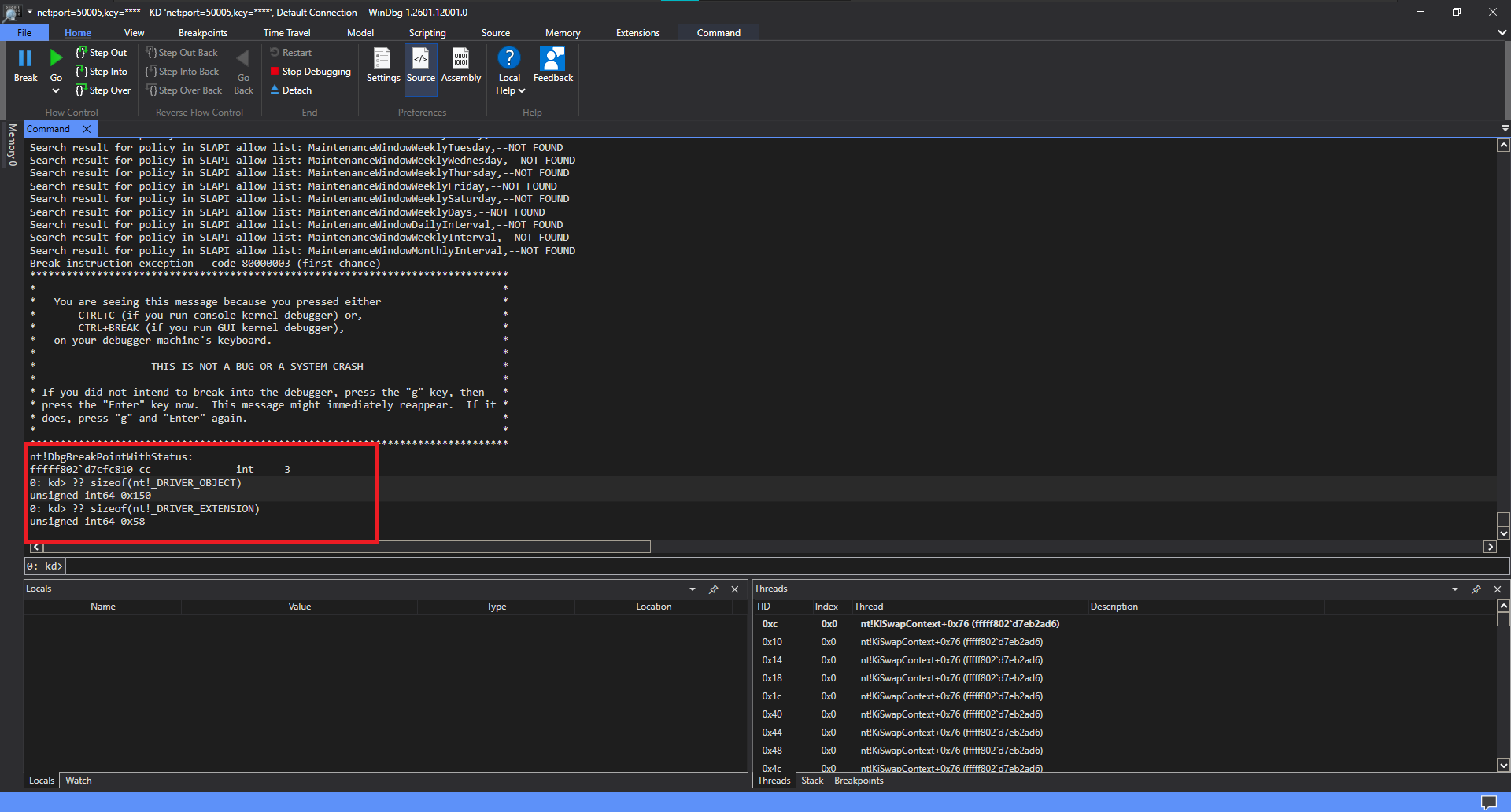
_Driver_Object and _Driver_Extenstion sizes
We can see that Size of _Driver_Object is 0x150 bytes and _Driver_Extenstion is 0x58 bytes and both together 0x150 + 0x58 = 0x1A8 which is exaclty what the ObCreateObjectEx uses.
DRIVER_EXTENSION initialization
Our Findings are verified again by looking at the Pseudocode of IoCreateDriver further:
    v7 = (char *)v20;
    memset_0(v20, 0, 0x1A8uLL);
Here, the OS zeros out 0x1A8 bytes. So, we do know that the OS allocated DRIVER_OBJECT and DRIVER_EXTENSION as one contiguous chunk. Further looking at the pseudocode, we can see the OS interacting with the _DRIVER_EXTENSION
// The Pointer Math (DriverExtension)
*((_QWORD *)v7 + 6) = v7 + 0x150;
v7 is cast as a 64-bit pointer (_QWORD*), so adding 6 moves the offset by 6 * 8 = 48 bytes (0x30). Offset 0x30 in a DRIVER_OBJECT is the DriverExtension pointer, which we can actually see:
struct_DRIVER_EXTENSION
//0x28 bytes (sizeof)
struct _DRIVER_EXTENSION
{
    struct _DRIVER_OBJECT* DriverObject;                                    //0x0
    LONG (*AddDevice)(struct _DRIVER_OBJECT* arg1, struct _DEVICE_OBJECT* arg2); //0x8
    ULONG Count;                                                            //0x10
    struct _UNICODE_STRING ServiceKeyName;                                  //0x18
};
and v7 + 0x150 is the base address plus the exact size of the DRIVER_OBJECT. Which means DRIVER_EXTENSION sits just below the DRIVER_OBJECT yet another confirmation. We can also see the OS setting up a back pointer to the _DRIVER_OBJECT here:
// The Back-Pointer
*((_QWORD *)v7 + 42) = v7;
Adding 42 to a _QWORD* moves the offset by 42 * 8 = 336 bytes (0x150) and what is at offset 0x150 The very first member of DRIVER_EXTENSION which is struct _DRIVER_OBJECT* DriverObject; the back-pointer.
Type and Size Initialization
The decompiler shows this strange line of code:
*(_DWORD *)v7 = 0x1500004;
This is a classic compiler optimization trick. Offset 0 of the DRIVER_OBJECT struct holds two consecutive 16-bit (SHORT) values: Type and Size. Instead of writing them separately, the compiler packed them into a single 32-bit DWORD write using Little-Endian formatting.
Memory Bit-Packing 0x01500004
The IoDriverObjectType
In the Windows kernel, IoDriverObjectType is an exported global variable which points to an _OBJECT_TYPE structure.
Think of the Windows Kernel in terms of Object-Oriented Programming. An *ObjectType variable (like IoDriverObjectType or PsThreadType) acts as a Class Definition.
The Object Manager needs these "Class Blueprints" to know exactly what kind of Instance it is dealing with, how to secure it, and how to safely destroy it. By passing IoDriverObjectType into ObCreateObject, we are giving the Object Manager the blueprint it needs to work with this raw memory.
IoDriverObjectType is am exported variable which we can verify in ida:
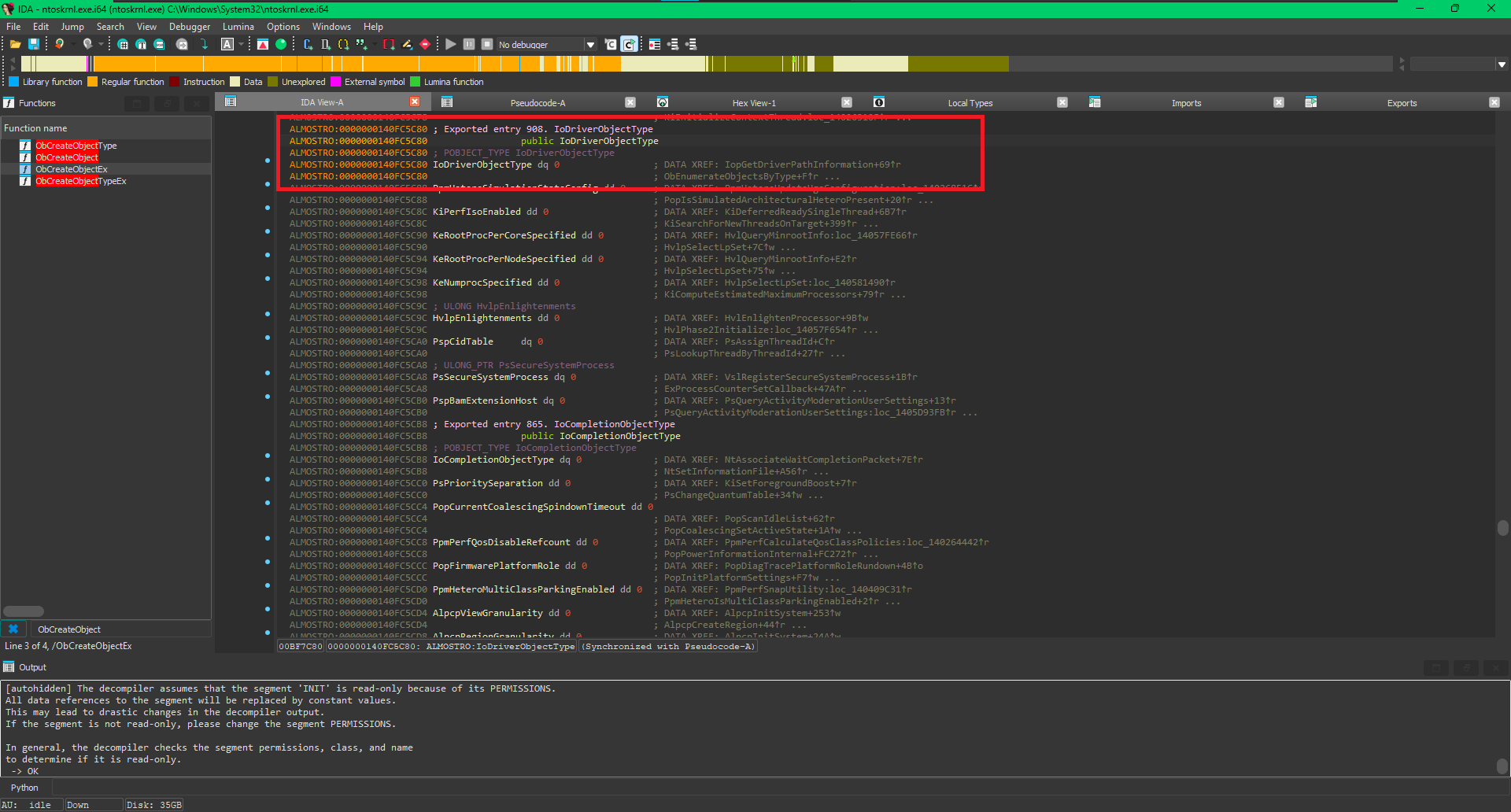
IoDriverObjectType Variable
As it is a globally exported variable we can me the compiler statically link it to our driver but this will leave a suspicious looking import in our Driver's PE.
extern POBJECT_TYPE IoDriverObjectType;
Dynamic Resolution
We can dynamically resolve IoDriverObjectType by looking at another loaded driver, specifically by targeting a built-in Windows device that is guaranteed to always be present, such as \Device\Tcp.
Step 1Get device object pointer
PDEVICE_OBJECT pTcpDeviceObject = NULL;

UNICODE_STRING tcpDeviceName;
RtlInitUnicodeString(&tcpDeviceName, L"\\Device\\Tcp");

// Get the device object pointer
PFILE_OBJECT pTcpFileObject = NULL;
status = IoGetDeviceObjectPointer(&tcpDeviceName, FILE_ANY_ACCESS, &pTcpFileObject, &pTcpDeviceObject);
if(!NT_SUCCESS(status))
{
  LOG_W("[ResolveIoDriverObjectType] [-] Failed to get TCP device object pointer: 0x%X\n", status);
  return nullptr;
}
IoGetDeviceObjectPointer doesn't just return the device object; it returns a FILE_OBJECT representing our open handle to the device, and a pointer to the target DEVICE_OBJECT itself.
Step 2Get Driver Object
// Get the driver object pointer
PDRIVER_OBJECT pTcpDriverObject = pTcpDeviceObject->DriverObject;
if(!pTcpDriverObject)
{
  LOG_W("[ResolveIoDriverObjectType] [-] TCP device has a NULL driver object.\n");

  ObDereferenceObject(pTcpFileObject);
  return nullptr;
}
Once we have the TCP device object, we simply dereference it to find its master driver object
Step 3Query the Object Manager
POBJECT_TYPE pDriverObjectType = pObGetObjectType(pTcpDriverObject);
if(!pDriverObjectType)
{
  LOG_W("[ResolveIoDriverObjectType] [-] pIoDriverObjectType is 0x%p\n", pDriverObjectType);

  ObDereferenceObject(pTcpFileObject);
  return nullptr;
}
The Object Manager looks at the object header of the TCP driver, extracts the pointer to its class definition (IoDriverObjectType), and hands it right back to us.
Step 4Cleanup
ObDereferenceObject(pTcpFileObject);
Because IoGetDeviceObjectPointer increments the reference count on the FILE_OBJECT we must call ObDereferenceObject when we are done. If we don't, we cause a memory leak and prevent the TCP driver from ever cleanly unloading.
Finally
Now we have all the stuff that is required to make ourselves a fake DriverObject which the OS will have no issues interacting with. We now know how the OS creates a driver using IoCreateDriver how it uses ObCreateObject to create DriverObject a and whatever it does with the _DRIVER_EXTENSION structure, and the initializations. We will replicate the behaviour of IoCreateDriver.
Create DriverObject
We begin by setting up an OBJECT_ATTRIBUTES structure. By providing NULL for the name and specifying the OBJ_KERNEL_HANDLE flag, we ensure our driver object remains anonymous (invisible to standard namespace directory queries) and strictly isolated from user-mode access.
OBJECT_ATTRIBUTES objAttributes;
InitializeObjectAttributes(&objAttributes, NULL, OBJ_KERNEL_HANDLE, NULL, NULL);

PDRIVER_OBJECT pFakeDriverObject = nullptr;

NTSTATUS status = pObCreateObject(KernelMode, pDriverObjectType, &objAttributes, KernelMode, (PVOID)NULL, sizeof(_DRIVER_OBJECT) + sizeof(_DRIVER_EXTENSION), 0, 0, (PVOID*)&pFakeDriverObject);
if(!NT_SUCCESS(status) || pFakeDriverObject == NULL)
{
  LOG_W("[CreateFakeDriverObject] [-] ObCreateObject failed. Status: 0x%X\n", status);
  return nullptr;
}
By passing sizeof(_DRIVER_OBJECT) + sizeof(_DRIVER_EXTENSION), we are mathematically replicating the exact 0x1A8 (424 byte) size we uncovered during our assembly trace of IoCreateDriver
Setup Type and Size
We saw IoCreateDriver setting up the Type and Size fields inside the _DRIVER_OBJECT structure, So we do the same which is very simple:
pFakeDriverObject->Type = 4; // 4 == IO_TYPE_DRIVER
pFakeDriverObject->Size = sizeof(_DRIVER_OBJECT);
Setup _DRIVER_EXTENSION
And Inside the _DRIVER_EXTENSION structure we need to populate the backpointer
pFakeDriverObject->DriverExtension = (PDRIVER_EXTENSION)(pFakeDriverObject + 1);

RtlZeroMemory(pFakeDriverObject->DriverExtension, sizeof(DRIVER_EXTENSION));
pFakeDriverObject->DriverExtension->DriverObject = pFakeDriverObject;
We set the extension pointer using pFakeDriverObject + 1. Because pFakeDriverObject is typed as a PDRIVER_OBJECT, adding 1 tells the C++ compiler to physically jump forward in memory by exactly sizeof(DRIVER_OBJECT) bytes
We do this because when we reverse engineered IoCreateDriver earlier, we saw that the OS allocates the DRIVER_OBJECT and the DRIVER_EXTENSION together as one massive, contiguous chunk of memory.
The End
We have successfully reverse engineered the Windows Kernel and forged a completely independent DRIVER_OBJECT from scratch.
Until next time, keep testing boundaries and stay stealthy.